

Introduction
Choosing therapy can feel confusing because there is no single treatment that works best for everyone. Different approaches focus on different goals, such as changing unhelpful thoughts, managing intense emotions, processing trauma, improving relationships, or understanding long-standing patterns.
The good news is that you do not have to identify the perfect therapy by yourself. A qualified mental health professional can help match an approach to your symptoms, goals, preferences, and circumstances. The American Psychological Association notes that therapists often combine approaches and adapt treatment to the individual.
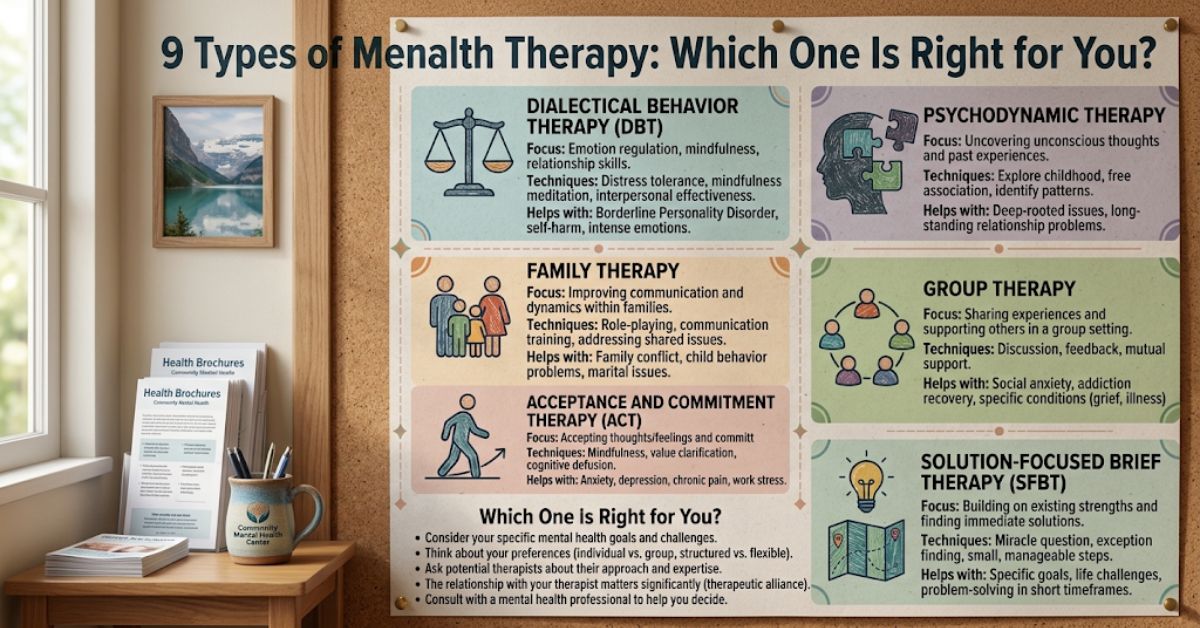
This guide explains 9 types of mental health therapy, what makes each one different, and what to consider when deciding which approach may be worth discussing with a professional.
What Is Mental Health Therapy?

Mental health therapy, often called psychotherapy or talk therapy, uses communication and therapeutic techniques to help people address emotional difficulties, thoughts, behaviors, relationships, and other psychological concerns.
Therapy can be provided individually or with couples, families, or groups. Different approaches use different methods. Some are highly structured and focus on current problems, while others spend more time exploring past experiences, relationships, emotions, or personal meaning.
There are also many more therapy approaches than the nine covered here. Psychology Today, for example, lists a large range of specific therapy modalities, while the APA groups psychotherapy approaches into broader categories such as psychodynamic, behavioral, cognitive, humanistic, and integrative approaches.
So, the nine types below should be viewed as a practical starting point—not a complete list of every therapy available.
At a Glance: 9 Types of Mental Health Therapy
| Therapy type | Main focus | Often considered for |
|---|---|---|
| Cognitive Behavioral Therapy (CBT) | Thoughts and behaviors | Anxiety, depression, OCD, stress and other concerns |
| Dialectical Behavior Therapy (DBT) | Emotion regulation and coping skills | Intense emotions, self-destructive behaviors, BPD and other concerns |
| Acceptance and Commitment Therapy (ACT) | Acceptance, mindfulness and values | Anxiety, depression, stress and other concerns |
| Psychodynamic Therapy | Past experiences and recurring patterns | Depression, relationship difficulties and deeper emotional concerns |
| Interpersonal Therapy (IPT) | Relationships and communication | Depression, grief and relationship-related difficulties |
| Exposure Therapy | Gradual exposure to feared situations | Phobias, anxiety disorders, OCD and PTSD |
| Family Therapy | Family relationships and patterns | Family conflict and problems affecting the family system |
| Group Therapy | Support and learning with others | Depression, anxiety, grief, trauma and other concerns |
| Mindfulness-Based Cognitive Therapy (MBCT) | Mindfulness and cognitive skills | Particularly recurrent depression and related concerns |
The suitability of a therapy depends on the individual and the problem being treated. Evidence-based treatment guidelines recommend different therapies for different conditions rather than treating one approach as universally best.
1. Cognitive Behavioral Therapy (CBT)

Cognitive Behavioral Therapy (CBT) is one of the most widely used and extensively studied forms of psychotherapy. It focuses on the connection between thoughts, feelings, and behaviors.
The basic idea is straightforward: unhelpful patterns of thinking can influence emotions and behavior. CBT helps people identify these patterns and develop more useful ways of responding.
For example, someone who repeatedly thinks, “I always fail,” may begin avoiding challenging situations. In CBT, the person may learn to examine that thought, look for evidence, develop a more balanced interpretation, and practice a different behavior.
CBT is generally practical and goal-oriented. Sessions may include exercises or activities that the person practices between appointments. The APA describes CBT as focusing on current problems and helping people develop coping skills through work during and outside therapy sessions.
What can CBT help with?
CBT is used for a wide range of mental health concerns. Depending on the specific CBT approach, it may be used for:
- Anxiety disorders
- Depression
- Obsessive-compulsive disorder (OCD)
- Post-traumatic stress disorder (PTSD)
- Eating disorders
- Stress
- Insomnia and other specific problems
The exact treatment plan depends on the person’s diagnosis, symptoms, and goals. CBT is also adapted into specialized forms for particular conditions.
What makes CBT different?
CBT is often a good fit for someone who wants a structured approach with practical skills and a clear focus on current difficulties. It does not necessarily ignore the past, but much of the work centers on patterns affecting the person now.
2. Dialectical Behavior Therapy (DBT)
Dialectical Behavior Therapy (DBT) is a structured therapy that grew from CBT and places a strong emphasis on balancing acceptance with change.
DBT was originally developed for people with borderline personality disorder, but it is now used in other situations involving difficulties with emotional regulation and self-destructive behaviors. The American Psychiatric Association describes DBT as a form of CBT that teaches skills for emotion regulation and can include both individual and group therapy.
DBT commonly teaches four major skill areas:
- Mindfulness: Paying attention to the present without automatically judging the experience.
- Distress tolerance: Handling difficult situations without making them worse.
- Emotion regulation: Understanding and managing intense emotional responses.
- Interpersonal effectiveness: Communicating needs, maintaining relationships, and setting boundaries.
These skills can be useful when emotions feel overwhelming or when emotional reactions repeatedly create problems in relationships or daily life.
Who might consider DBT?
DBT may be particularly relevant for people experiencing severe emotional dysregulation, borderline personality disorder, recurrent self-destructive behaviors, or certain other difficulties for which DBT has evidence. It should be selected with guidance from a qualified professional rather than based on a symptom checklist alone.
3. Acceptance and Commitment Therapy (ACT)
Acceptance and Commitment Therapy (ACT) takes a different approach to difficult thoughts and emotions. Instead of making the elimination of uncomfortable feelings the central goal, ACT helps people develop psychological flexibility.
This means learning to notice difficult thoughts and feelings without automatically allowing them to control behavior.
ACT combines elements such as:
- Mindfulness
- Acceptance
- Values clarification
- Behavioral change
- Commitment to meaningful actions
For example, a person may experience anxiety before an important social event. Rather than waiting until the anxiety disappears before participating, ACT can help the person acknowledge the anxiety and still take an action that fits their values.
ACT developed from behavioral therapy and is recognized as a distinct psychotherapy approach.
When might ACT be useful?
ACT has been studied for several concerns, including anxiety, depression, stress, chronic pain, and substance-use-related problems. The specific evidence varies by condition, so treatment should be matched to the individual’s needs.
ACT may appeal to someone who wants to learn how to live meaningfully while dealing with difficult internal experiences rather than constantly trying to eliminate every uncomfortable thought or emotion.
4. Psychodynamic Therapy
Psychodynamic therapy focuses on understanding emotional patterns, relationships, past experiences, and thoughts or feelings that may operate outside a person’s immediate awareness.
The approach can help a person explore questions such as:
- Why do I keep responding to similar situations in the same way?
- Why do certain relationships repeatedly become difficult?
- Where might particular emotional patterns come from?
- How do earlier experiences influence the way I relate to people today?
Unlike highly structured approaches that may concentrate primarily on present symptoms, psychodynamic therapy can spend more time examining the underlying patterns behind current difficulties.
The APA describes psychodynamic approaches as focusing on problematic behaviors, feelings, and thoughts by exploring their unconscious meanings and motivations.
Psychodynamic therapy is also used for depression and other psychological concerns. Current APA guidance on depression describes it as an approach that explores unconscious thoughts, early experiences, and the therapeutic relationship to understand current challenges.
Who may prefer psychodynamic therapy?
It may suit someone who wants deeper self-understanding and is interested in exploring recurring emotional or relationship patterns. However, the best choice depends on the person’s circumstances and the therapist’s expertise. There is no universal rule that one therapy style is better than another for everyone.
5. Interpersonal Therapy (IPT)
Interpersonal Therapy (IPT) focuses on the connection between a person’s mental health and their relationships with other people. Rather than exploring every area of a person’s life, IPT usually concentrates on specific relationship problems or major life changes that may be contributing to emotional distress.
IPT commonly addresses areas such as:
- Conflict with a partner, family member, friend, or coworker
- Grief and loss
- Major life transitions
- Changes in social roles
- Difficulty communicating or maintaining relationships
The goal is to improve interpersonal functioning and help the person manage relationship-related stress more effectively.
IPT is particularly associated with the treatment of depression, and it has also been adapted for other mental health concerns. The approach is generally structured and focuses on current relationships rather than spending most of the therapy exploring distant experiences.
What does IPT look like?
A therapist may help you identify a relationship problem, understand how it affects your emotions, and practice healthier communication or coping strategies.
For example, someone experiencing depression after a major relationship change may work with an IPT therapist to understand the change, process associated emotions, and rebuild supportive relationships.
6. Exposure Therapy
Exposure therapy involves gradually and safely facing situations, objects, thoughts, or memories that trigger fear or anxiety.
Avoidance can provide short-term relief, but repeatedly avoiding something frightening can sometimes maintain the fear. Exposure therapy works by helping a person approach the feared experience in a controlled therapeutic setting rather than automatically escaping from it.
Exposure can take different forms depending on the problem. A therapist might use:
- In vivo exposure: Facing a real-life situation.
- Imaginal exposure: Carefully imagining a feared situation.
- Interoceptive exposure: Experiencing physical sensations associated with anxiety in a controlled way.
- Virtual or technology-assisted exposure: Using technology to recreate certain situations when appropriate.
Exposure therapy is an important evidence-based treatment for several anxiety-related conditions, including specific phobias, panic disorder, social anxiety disorder, and OCD. Exposure-based approaches are also used as part of treatment for PTSD.
Is exposure therapy the same as forcing yourself to face a fear?
No. Effective exposure therapy is planned and gradual, with the therapist considering the person’s condition, safety, treatment goals, and ability to tolerate the exercise.
The objective is not to overwhelm someone. Instead, the therapist helps the person learn new ways of responding to fear and anxiety.
7. Family Therapy
Family therapy looks at psychological or behavioral difficulties within the context of family relationships and interactions.
The word “family” does not necessarily mean only parents and children. Depending on the therapy, participants may include partners, siblings, caregivers, or other important people in someone’s support system.
A family therapist may help participants:
- Communicate more clearly
- Understand recurring relationship patterns
- Reduce destructive conflict
- Establish healthier boundaries
- Solve shared problems
- Support a family member experiencing mental health difficulties
Family therapy can be especially useful when relationship dynamics are closely connected to the problem being addressed.
For example, if a teenager is struggling emotionally and family conflict is making the situation harder, therapy may involve both the teenager and family members rather than focusing exclusively on the teenager.
Family therapy is not about deciding who is “at fault.” The focus is usually on understanding patterns and finding healthier ways for people to interact.
8. Group Therapy
Group therapy involves one or more mental health professionals working with several people who meet together for therapeutic purposes.
Groups can be organized around a shared concern, treatment approach, or population. Depending on the setting, people may discuss experiences, practice coping skills, receive feedback, and learn from others facing similar challenges.
A group may focus on:
- Anxiety
- Depression
- Grief
- Trauma
- Addiction and recovery
- Stress management
- Social skills
- Specific therapeutic skills
One potential advantage of group therapy is that participants can realize they are not the only person dealing with a particular challenge. Hearing how others cope can also introduce perspectives that may not emerge in individual therapy.
However, group therapy is not ideal for everyone. Some people may feel uncomfortable discussing personal experiences in front of others, while others may benefit greatly from the shared environment.
A qualified therapist can help determine whether a group format is appropriate for a particular situation.
9. Mindfulness-Based Cognitive Therapy (MBCT)
Mindfulness-Based Cognitive Therapy (MBCT) combines mindfulness practices with elements of cognitive therapy.
It was developed in part to help people who have experienced recurrent depression. The approach teaches people to become more aware of thoughts, emotions, and physical sensations without immediately reacting to them.
Instead of automatically accepting a negative thought as true, a person learns to notice it as a mental event.
For example:
“I’m going to fail” becomes “I’m noticing the thought that I might fail.”
That small change can create space between the thought and the person’s reaction.
MBCT incorporates mindfulness exercises alongside cognitive techniques and is particularly associated with preventing relapse in people with recurrent depression.
How is MBCT different from regular CBT?
CBT often focuses directly on identifying and changing unhelpful thought patterns and behaviors. MBCT also uses cognitive techniques but places greater emphasis on mindful awareness and changing the relationship a person has with their thoughts and feelings.
The two approaches can therefore overlap while emphasizing different skills.
How Do You Choose the Right Type of Mental Health Therapy?
Knowing the names of different therapies is useful, but choosing one is not simply a matter of picking the approach that sounds best.
A better starting point is to consider what you want help with.
1. Start with your main concern
Think about the problem that brought you to therapy.
Is it mainly:
- Persistent sadness?
- Anxiety or panic?
- A specific fear?
- Trauma-related symptoms?
- Relationship conflict?
- Difficulty controlling emotions?
- Grief?
- Repeated unhealthy patterns?
Your answer can help a mental health professional identify approaches that may be appropriate.
2. Consider your treatment goals
Two people with similar symptoms may have very different goals.
One person may want practical strategies for managing anxiety. Another may want to understand long-standing relationship patterns. Someone else may primarily want help processing a traumatic experience.
Tell the therapist what you hope will change.
3. Think about the therapy format
Therapy may take place:
- Individually
- With a partner
- With family members
- In a group
- In person
- Through online sessions, where appropriate
The format can affect how comfortable and useful treatment feels.
4. Consider the therapist, not just the therapy name
A therapy method matters, but so does the therapeutic relationship.
Look for a qualified professional who has appropriate training and experience with the problem you want to address. You should also feel able to ask questions about the treatment plan, goals, expected process, and alternatives.
A specific therapy may be evidence-based, but that does not mean every therapist will be the right fit for every person.
5. Be open to adjustment
Therapy is not always a one-time decision.
Your therapist may adjust the approach as they learn more about your needs. Some professionals use an integrative approach, combining techniques from different evidence-based therapies when appropriate.
If therapy does not feel helpful, that does not automatically mean therapy itself has failed. It may be worth discussing what is not working with your therapist or seeking another professional for a second opinion.
How Long Does Mental Health Therapy Take?
There is no single therapy length that applies to everyone.
Some structured therapies are commonly delivered over a defined number of sessions, while other forms of psychotherapy may continue for longer depending on the person’s goals and circumstances.
Duration can depend on factors such as:
- The type and severity of the problem
- Treatment goals
- The therapy approach
- Progress during treatment
- Personal circumstances
- Whether other treatments are involved
Rather than choosing therapy based only on how quickly it might finish, discuss expected duration and treatment goals with the therapist.
Can Different Types of Therapy Be Combined?
Yes. Mental health professionals may use an integrative or combined approach when appropriate.
For example, a therapist might use cognitive techniques while also incorporating mindfulness, behavioral exercises, or interpersonal strategies.
The important point is that combining techniques should have a clinical reason. More therapy methods do not automatically mean better treatment.
Treatment should be tailored to the person’s needs, preferences, diagnosis when applicable, and available evidence.
Therapy Is Not Always the Same as Medication
Psychotherapy and medication are different forms of mental health treatment.
Some people receive psychotherapy alone. Others may benefit from medication, psychotherapy, or a combination of treatments depending on their condition and individual circumstances.
A doctor, psychiatrist, psychologist, therapist, or other appropriately qualified professional can help determine what treatment options should be considered.
For some mental health conditions, treatment may also involve lifestyle changes, social support, crisis services, or other interventions.
The right treatment plan depends on the individual—not simply on the name of a diagnosis or therapy.
Common Mistakes When Choosing Therapy
Choosing a therapy only because it is popular
A widely known therapy is not automatically the best choice for your particular concern. Relevance to your needs matters more than popularity.
Expecting one session to solve everything
Therapy is generally a process. Progress can take time, and the pace differs between people and conditions.
Assuming discomfort means therapy is failing
Some therapeutic work can be emotionally difficult. However, significant concerns about safety, boundaries, treatment methods, or the therapeutic relationship should be discussed openly with the professional.
Staying silent when something feels wrong
You should be able to ask why a particular technique is being used and what the treatment is intended to accomplish.
If you do not understand the plan, ask.
Treating online information as a diagnosis
Articles and symptom lists can help you understand mental health concepts, but they cannot replace an assessment by a qualified professional.
FAQs
What is the most common type of mental health therapy?
Cognitive Behavioral Therapy (CBT) is one of the most widely used forms of psychotherapy. However, the most appropriate therapy depends on the person’s concerns, goals, circumstances, and clinical needs.
Which therapy is best for anxiety?
Several approaches can be used for anxiety, including CBT and exposure-based therapies. The best option depends on the specific anxiety problem and the individual’s needs.
Which therapy is commonly used for depression?
CBT, interpersonal therapy, psychodynamic therapy, and other evidence-based approaches may be used for depression. Treatment selection depends on factors such as the person’s symptoms, preferences, history, and clinical situation.
What type of therapy helps with trauma?
Trauma-focused approaches can be used for trauma-related difficulties. Depending on the person’s circumstances, treatment may include specific trauma-focused CBT approaches, exposure-based methods, or other evidence-based treatments.
Can therapy really help mental health?
Consider speaking with a qualified mental health professional if emotional or psychological difficulties are interfering with your daily life, relationships, work, studies, sleep, or ability to function. You do not need to wait until a problem becomes severe before seeking professional support.
CONCLUSION
The 9 types of mental health therapy covered here—CBT, DBT, ACT, psychodynamic therapy, IPT, exposure therapy, family therapy, group therapy, and MBCT—use different methods and emphasize different goals.
There is no universal “best” therapy for everyone. The right starting point depends on what you are experiencing, what you want to change, your preferences, and the expertise of the professional providing treatment.
If you are considering therapy, start by describing your main concern and goals to a qualified mental health professional. From there, you can discuss which approaches may be appropriate and what treatment plan makes sense for you.